ARE THE HURRICANE FANS TROLLS? Miami's Biggest Enemy Might Be Wearing Orange and Green
Studio 1 Live Sports | Miami Hurricanes Football | Opinion & Commentary
Miami is undefeated, ranked No. 1 in America, and chasing another national championship. So why do some Hurricanes fans sound more like Miami's enemies than its supporters?
Miami is No. 1 — so why are some fans already predicting failure?
There's something strange happening inside Hurricane Nation.
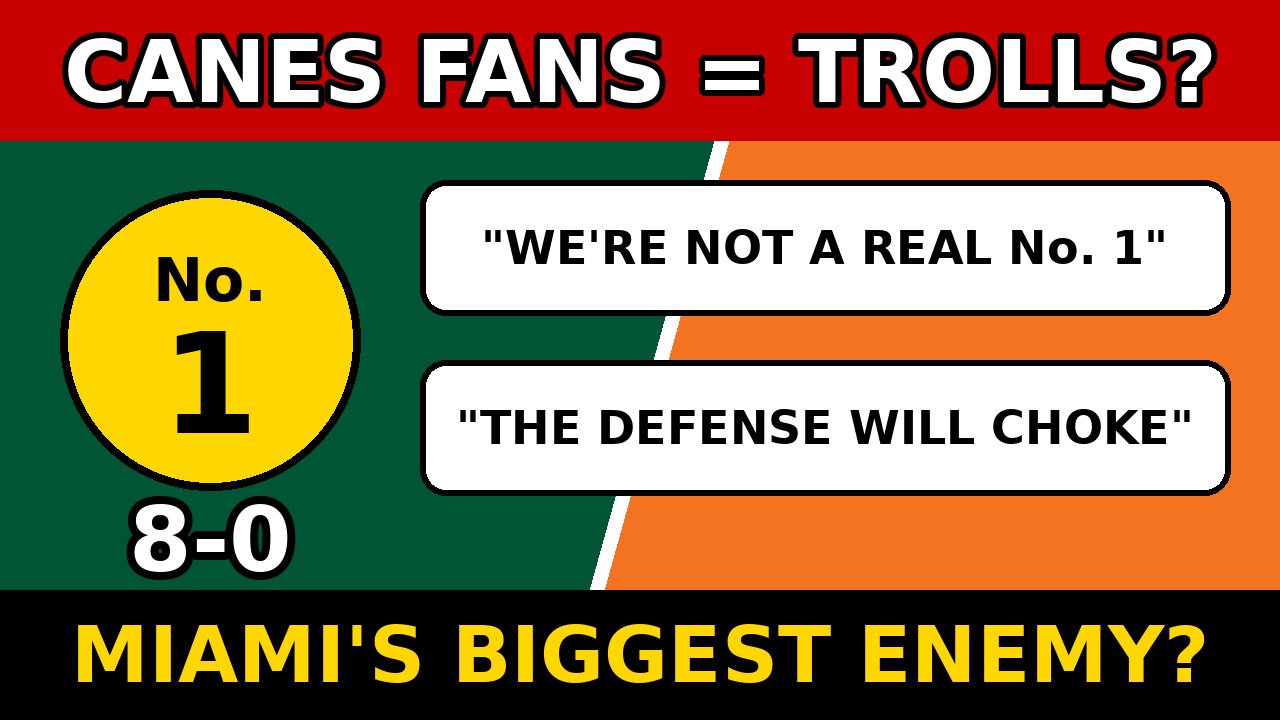
The Miami Hurricanes are 8–0. They're ranked No. 1 in both the AP Poll and the College Football Playoff rankings. They're in position to compete for a national championship.
Yet listen to some of their own fans:
- "We're not a real No. 1 team."
- "Our luck is going to run out."
- "This defense is going to cost us a championship."
- "We can't beat the elite teams."
- "We're going to get exposed."
Wait a minute. Are these Miami Hurricanes fans, or are they trolls wearing orange and green?
At some point, constant negativity stops sounding like football analysis and starts sounding like the same propaganda Miami's rivals have been pushing for years. And here's the bigger question: what happens when the people who are supposed to believe in a team become the loudest voices telling that team it isn't good enough?
The 2024 defense narrative is back — but is it even the same team?
Remember the 2024 Miami Hurricanes? That team had an explosive offense led by Cam Ward, but defensive problems became the centerpiece of the national conversation. The narrative became simple: Miami couldn't be trusted because its defense wasn't championship-caliber.
That criticism had a legitimate statistical foundation. But the larger debate was how that weakness was used to judge Miami against other playoff contenders, including Notre Dame.
Now we're hearing a familiar message in 2026. Miami's defense is supposedly going to collapse. Miami supposedly can't beat the best teams. Miami supposedly isn't a real championship contender. And some Miami fans are repeating those predictions as though they're established facts.
The 2026 Hurricanes are not the 2024 Hurricanes. They have different personnel, different results, and a different season unfolding in front of them.
- If the defense gives up too many explosive plays, criticize those plays.
- If the tackling is poor, demand better tackling.
- If the defensive coordinator makes questionable decisions, challenge those decisions.
That's football analysis. But saying this team is destined to fail because a previous Miami team struggled defensively? That's not analysis. That's recycling an old narrative.
Are you supporting the Hurricanes or planting doubt?
Let's talk about something that doesn't appear in the box score: confidence. Football is a physical game, but it's also psychological. Championship teams need quarterbacks who believe they can lead a fourth-quarter comeback, defensive backs who believe they can make the next play even after giving up a touchdown, and coaches who can keep an entire locker room focused under pressure.
Now imagine those players constantly hearing their own supporters say: "You're not good enough." "You're overrated." "You're going to choke." What kind of message is that?
Of course, college athletes must learn to handle criticism, and nobody is suggesting a team will lose simply because fans complain on social media. But there is a difference between demanding excellence and spreading defeatism.
Criticism identifies something that needs to improve. Defeatism declares failure before the opportunity to succeed has even arrived.
If your favorite team is undefeated and ranked No. 1, why are you spending more energy explaining why it can't win than discussing how it can?
The 2001 Hurricanes: the greatest team ever — or an impossible standard?
Let's address the elephant in the room. The 2001 Miami Hurricanes were one of the greatest collections of college football talent ever assembled: Ed Reed, Sean Taylor, Andre Johnson, Clinton Portis, Willis McGahee, Jonathan Vilma, Jeremy Shockey, Bryant McKinnie. That roster was loaded with future NFL talent, and it dominated its way to a national championship.
For more than two decades, that team has been the standard against which every Miami program is measured. But the 2001 Hurricanes cannot be the only acceptable version of championship football.
Does every victory have to be a blowout? Does every defensive possession have to end in a punt? Does every player have to become a future NFL superstar? Of course not. Some teams win with defense, some with explosive offenses, and some survive close games, overcome injuries and get stronger as the season goes on.
The goal is not to recreate 2001. The goal is to win the next national championship. If the 2026 Hurricanes accomplish that, nobody gets to tell them they aren't real champions because they didn't look exactly like the 2001 roster.
"We're not back until we win a championship!"
Every season, Miami fans hear the same question: "Is The U back?" And some fans immediately respond: "We're not back until we win a national championship!"
Fine. Let's accept that standard. But how can Miami win another national championship if its own fans refuse to believe the team is capable of winning one?
You cannot demand a championship while treating every championship opportunity like a guaranteed disappointment. You cannot spend the entire season predicting failure and then pretend you were supporting the team all along if it wins.
Being back isn't just a slogan. It's a process that has to lead somewhere. And right now, Miami has put itself in position to finish that process.
There's a difference between a critical fan and a troll
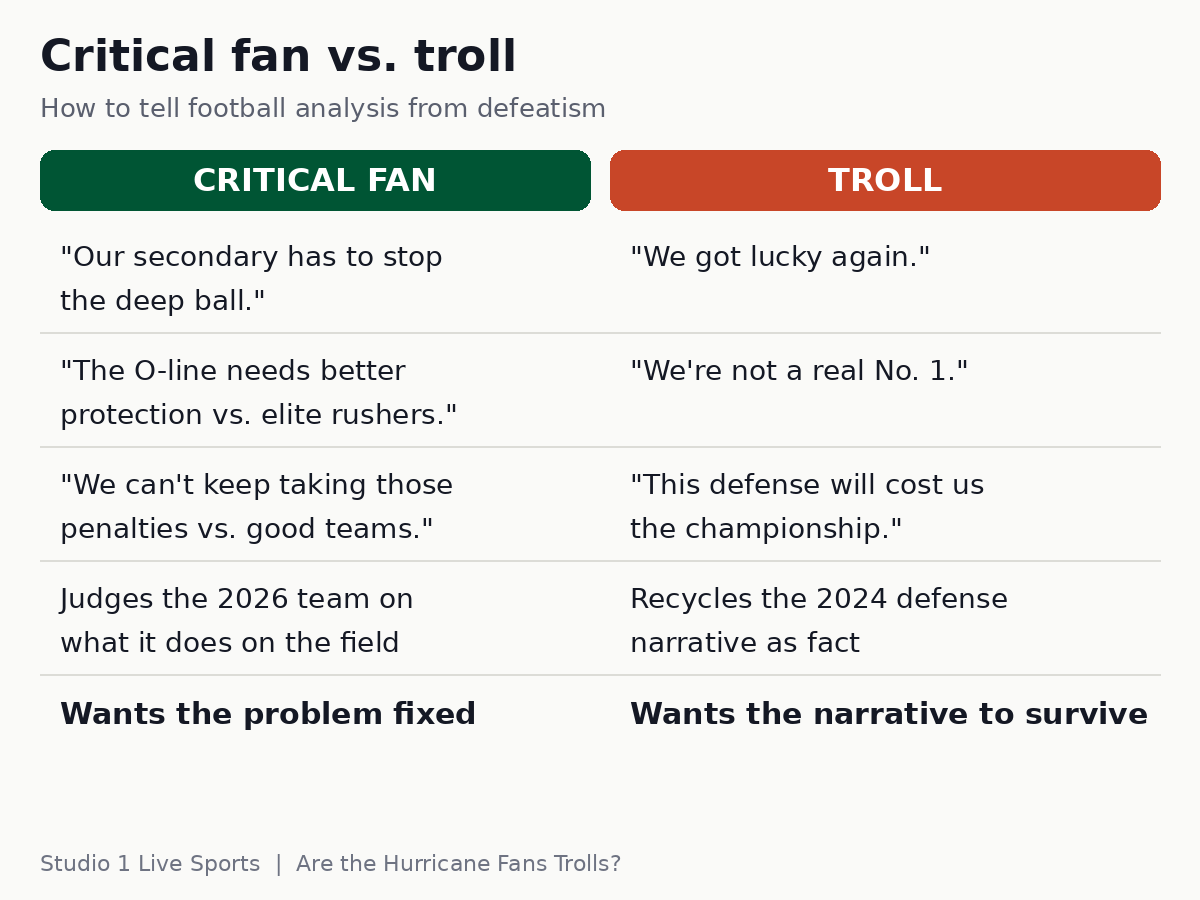
Not every fan who criticizes Miami is a troll. "Our secondary needs to improve against deep passes" is a football argument. "Our offensive line needs better protection against elite pass rushers" is a concern. "We can't keep making those penalties against championship opponents" is accountability.
But the fan who responds to every victory by saying Miami was lucky? Who dismisses every opponent Miami beats? Who predicts disaster every week and treats a close win as proof the Hurricanes are frauds? That fan is behaving like a troll, whether they realize it or not.
A real critic wants a problem corrected. A troll wants the negative narrative to survive. One is trying to make the team better. The other keeps moving the goalposts so the team can never be good enough.
The double standard: Miami has to be perfect, everybody else gets excuses
When another highly ranked team struggles against an inferior opponent, commentators praise its toughness: "They found a way to win." "That's what championship teams do." But when Miami wins a close game? "They got lucky." "They're overrated."
Performance matters. Opponent quality matters. Injuries and coaching decisions matter. But those standards should apply equally to everyone. If Georgia, Alabama, Ohio State or Notre Dame can win an ugly game and still be considered championship contenders, Miami deserves the same opportunity — and Miami's own supporters shouldn't adopt the double standard.
Championship expectations should raise standards, not destroy confidence
There's nothing wrong with expecting Miami to win a national championship. That's exactly what Hurricane Nation should expect from a program with Miami's history. But expectations must come with perspective.
- When the defense plays poorly, criticize the defense.
- When the offense stalls, question the play-calling.
- When the team commits unnecessary penalties, demand discipline.
- When coaches make mistakes, hold them accountable.
But when the Hurricanes win, recognize the victory. When they overcome adversity, recognize their resilience. And when they're undefeated and ranked No. 1, stop acting like their success is an accident waiting to be exposed. You can believe Miami is good enough to win a championship and still recognize it has problems to fix. Those two positions are not contradictory.
Hurricane Nation: do you want to be right about failure, or do you want Miami to win?
Suppose you've spent the entire season saying the defense would collapse, the team was overrated, the luck would run out. Then Miami wins it all. Are you happy? Or upset because the team proved your predictions wrong?
A real fan should be delighted to be wrong about a weakness that gets corrected. The objective was never to win an argument on social media. The objective was to see the Miami Hurricanes win another national championship.
Final word: stop acting like the Hurricanes have already lost
Miami has not won the 2026 national championship, and nobody should pretend otherwise. There are difficult games ahead. But Miami also hasn't failed. The Hurricanes are undefeated, ranked No. 1, and have earned the right to compete for college football's biggest prize.
The 2001 Hurricanes already made history. The 2026 Hurricanes are trying to make their own. Let them.
Criticize the mistakes. Demand improvement. Hold the coaches accountable. But stop confusing pessimism with intelligence, and stop treating belief in your own team like it's foolish. Because if Miami finally raises that national championship trophy again, Hurricane Nation should be celebrating together — not explaining why it still wasn't good enough.
So: are some Hurricane fans actually trolls? Or have years of disappointment conditioned them to expect failure even when success is staring them in the face? That's the debate, and I want to hear what Hurricane Nation has to say.
Join the debate — Studio 1 Live Sports
Watch on YouTube: Are the Hurricane Fans Trolls?
Do Miami fans have legitimate concerns about the defense, or are some supporters poisoning the championship conversation with constant negativity? Watch the discussion, share your opinion in the comments, and tell us whether the 2026 Hurricanes deserve more respect from their own fan base.
YouTube: youtube.com/@herudaguru · Sports coverage: studio1live.com/picks